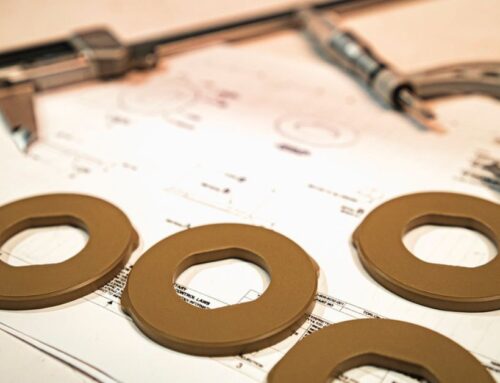
Advanced industries continue to replace metals with high-performance polymers to solve weight, corrosion, and thermal challenges. Custom plastic components now support critical systems that operate in extreme temperatures, chemically aggressive environments, and tightly controlled cleanrooms. Read on to learn how engineered materials support performance across demanding sectors as we look at industry use cases for custom plastics.
Electronics
Electronics manufacturers rely on custom plastic components to insulate, support, and protect sensitive assemblies. Designers select materials that maintain dimensional stability during thermal cycling and provide strong dielectric properties. Ultem® and Polyimide frequently meet these requirements because they resist heat and maintain electrical insulation in compact assemblies.
Engineers often use Polyimide in high-temperature test sockets, circuit board fixtures, and insulating barriers. Ultem® performs well in structural electrical components that require flame resistance and long-term stability. These materials also resist creep, which helps maintain alignment in connectors and board-level hardware over time.
Miniaturization continues to drive tighter tolerances in electronic systems. Small dimensional shifts can disrupt contact force, impedance control, or mechanical engagement. Therefore, engineers evaluate both material properties and machinability to ensure the finished component performs reliably within densely packed assemblies.
Aerospace
Another industry that can provide a use case for custom plastics is the aerospace sector. Its engineers focus on reducing system weight while maintaining structural integrity and safety. High-performance plastics such as PEEK and Torlon® provide strong mechanical performance without the density of traditional metals. Designers integrate these materials into bearing cages, brackets, insulators, and interior cabin structures.
PEEK maintains strength at elevated temperatures and resists aviation fluids, fuels, and hydraulic chemicals. Meanwhile, Torlon® delivers exceptional compressive strength and wear resistance in dynamic components exposed to high loads. Engineers often choose these polymers for parts that must endure vibration, repeated stress, and wide temperature swings.
Aerospace applications also demand predictable long-term behavior. Designers evaluate creep resistance, fatigue performance, and thermal expansion coefficients during the material selection phase. When polymer components replace metal parts, engineers must account for differences in stiffness and expansion to maintain system alignment and reliability.

Oil and Gas
Oil and gas environments expose components to extreme pressure, temperature swings, and aggressive chemicals. When engineers design seals, valve seats, insulators, and pump components, they must endure these conditions without failure. High-performance plastics offer corrosion resistance and weight reduction compared to metal alternatives.
For example, Torlon® handles high compressive loads in sealing and structural applications. PEEK resists hydrocarbons and maintains mechanical integrity in downhole tools and surface equipment. Polyphenylene sulfide (PPS) delivers dimensional stability in chemically aggressive fluids and elevated temperatures.
Designers evaluate long-term creep, thermal expansion, and chemical compatibility when selecting materials for oilfield systems. They also consider how pressure and temperature cycling may influence dimensional stability over time. Custom plastic components often help extend service life and reduce maintenance in challenging drilling and production environments.
Food Processing
Food and beverage facilities operate in environments that demand strict sanitation and chemical resistance. Engineers specify custom plastic components for guides, rollers, wear strips, and processing equipment. Their materials must withstand repeated washdowns, moisture exposure, and sanitizing agents without degrading.
PEEK and PPS meet these requirements by resisting chemical attack and maintaining dimensional stability in high-temperature cleaning cycles. Additionally, Ultem® provides structural strength where equipment design requires durable support components. Engineers select materials that minimize moisture absorption to reduce the risk of swelling or bacterial retention.
Designers also consider surface finish and geometry when developing food processing components. Smooth, precisely machined surfaces support hygienic design and simplify cleaning procedures. Proper material selection and fabrication help facilities maintain uptime while meeting regulatory requirements.
Medical Device Manufacturing
Another industry where custom plastics have proven useful is the medical device sector. Manufacturers require materials that will perform reliably under sterilization and repeated use. Engineers incorporate custom plastic parts into diagnostic equipment, surgical instruments, imaging systems, and device housings. Material consistency and dimensional accuracy directly influence device performance and patient safety.
PEEK offers strong mechanical performance, and Vespel® withstands high temperatures and reduces wear in dynamic medical assemblies that involve repeated motion. These materials also maintain structural integrity in environments exposed to disinfectants and cleaning agents.
Engineers must carefully match material properties with regulatory and performance requirements. They often evaluate creep resistance, wear characteristics, and dimensional stability under autoclave cycles.
Chemical Processing
Chemical processing facilities depend on materials that resist acids, solvents, and reactive compounds. Engineers incorporate custom plastic components into pumps, housings, seals, manifolds, and structural supports. Material failure in these environments can disrupt production and increase operational risk.
PEEK and PPS resist a broad range of chemicals while maintaining structural strength at elevated temperatures. Polyimide and Vespel® also perform well in high-temperature systems that demand thermal stability and low wear. Engineers evaluate compatibility charts and real-world performance data before finalizing specifications.
Designers also prioritize materials with low moisture absorption and predictable expansion rates. By aligning material selection with process conditions, engineers can improve reliability and reduce unplanned downtime.

Semiconductor Manufacturing
Semiconductor fabrication requires materials that minimize particle generation and outgassing. Engineers design wafer-handling components, spacers, and process-chamber parts that must perform reliably in ultra-clean environments. Dimensional precision plays a critical role in protecting wafers and maintaining production yield.
PEEK and Ultem® support cleanroom compatibility with low contamination risk and strong chemical resistance. Vespel® performs well in high-temperature fabrication steps that require wear resistance and stability. These materials help maintain performance in plasma environments and chemical vapor deposition processes.
Engineers must account for thermal expansion and mechanical stress within tightly controlled equipment. Even minor deviations can affect wafer alignment or process uniformity. Careful material selection and high-precision fabrication support consistent results across repeated manufacturing cycles.
Water and Waste Treatment
Water and wastewater systems expose materials to moisture, chemicals, and fluctuating mechanical loads. Engineers use custom plastic components in pumps, filtration systems, valves, and structural supports. These materials must resist hydrolysis and chemical attack over extended service periods.
PPS maintains stability in wet and chemically active environments. Additionally, PEEK provides higher mechanical strength in load-bearing applications within treatment systems.
Infrastructure applications require predictable long-term behavior. Designers will assess creep resistance and dimensional stability to ensure their components maintain sealing and alignment over years of operation. Properly selected high-performance plastics can reduce corrosion-related failures and support more efficient system maintenance.
After learning how engineers across various sectors have adopted high-performance plastics for demanding applications, you can see how they have provided solutions in environments where metals often struggle. Precision machining transforms these advanced polymers into components that meet exact dimensional and performance requirements.
When your project calls for high-tolerance, custom plastic components and you need the help of a high-quality plastic fabrication company, consider partnering with Plastic Machining Inc. Reach out to us today to learn how we can use all of the materials listed in this blog to bring your engineered designs to life.